






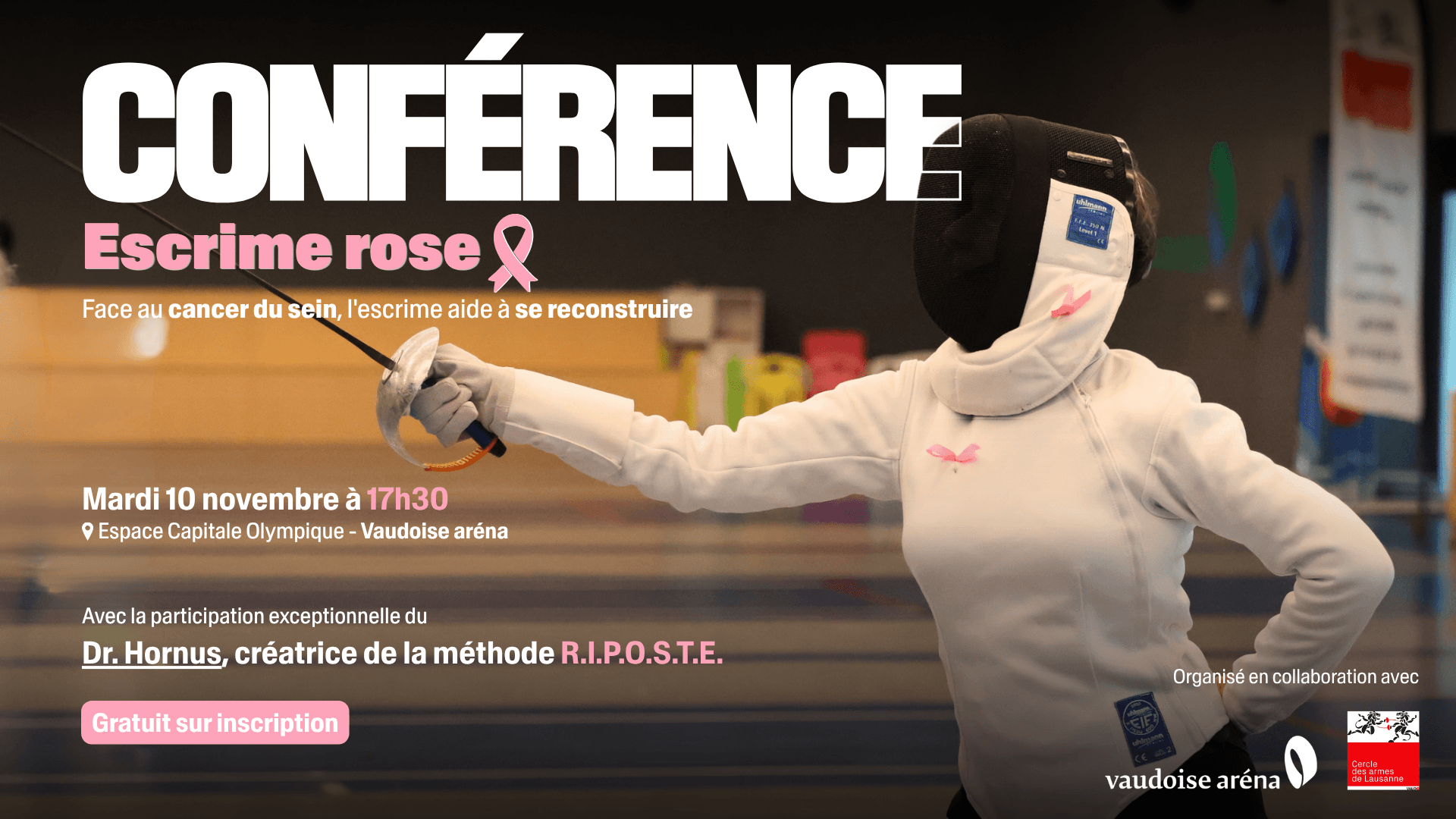
Conference: how R.I.P.O.S.T.E. fencing supports people affected by breast cancer
Discover the R.I.P.O.S.T.E. method at a free conference organised by the Vaudoise aréna and the Cercle des Armes de Lausanne, on Tuesday 10 November 2026 at 5:30 pm.
Physical activity plays an essential role throughout breast cancer care. It helps improve quality of life, regain mobility and support physical and psychological well-being. Among the approaches available, R.I.P.O.S.T.E. fencing offers an original way to support women in their recovery.
What is the R.I.P.O.S.T.E. method?
Developed in France in 2014 by Dr Dominique Hornus, an anaesthetist, in collaboration with health and fencing professionals, the R.I.P.O.S.T.E. method (Reconstruction, Image de soi [self-image], Posture, Oncologie [oncology], Santé [health], Thérapie [therapy], Escrime [fencing]) is an adapted fencing approach for people affected by breast cancer.
Already established in France, the method is still little known in Switzerland.
The Cercle des Armes de Lausanne is now committed to developing it in French-speaking Switzerland, with the ambition of building new bridges between sport and the medical world.
Led for several years by Vivian Garnier, fencing master at the Cercle des Armes de Lausanne, the project is taking on a new dimension thanks to the club's move to the Vaudoise aréna and the arrival of Miguel Baroudi, a fencing master trained and certified in the R.I.P.O.S.T.E. method.
Why practise fencing after a breast cancer diagnosis?
Open to people of all ages, whether or not they are used to sport, R.I.P.O.S.T.E. fencing offers an adapted physical activity, led by specially trained professionals and practised with the agreement of the medical team.
Through specific sabre movements, notably high parries, the practice aims to improve shoulder mobility, work on posture and regain ease in everyday movements.
Beyond the physical benefits sought, it also supports reclaiming one's body, self-confidence and the pleasure of rejoining a group activity, all of which matter in the recovery process.
Conference programme
This event will introduce the R.I.P.O.S.T.E. method, its goals and its practical application, through:
- A presentation of the method by Dr Dominique Hornus, its creator
- A demonstration of adapted fencing according to the R.I.P.O.S.T.E. method
- A round table with sports and health professionals
- A discussion with the audience, followed by drinks and nibbles
Speakers
- Dr Dominique Hornus – Anaesthetist and creator of the R.I.P.O.S.T.E. method
- Miguel Baroudi – Fencing master at the Cercle des Armes de Lausanne, certified in the R.I.P.O.S.T.E. method
- Ms Hungerbühler – Nurse and former participant in the method
- Cristina Garcia Toro – Physiotherapist
- Didier Jallut – Oncologist, Medical Director of the Lausanne Breast Network
Other speakers may join the round table.
Practical information
- Date: Tuesday 10 November 2026
- Doors open: 5:00 pm
- Conference starts: 5:30 pm
- Admission: Free, registration required
- Venue: Espace Capitale Olympique – Vaudoise aréna – Entrance B – Lausanne
Registration
Attendance is free, but registration is required.
Register for the conference
Getting here
The Vaudoise aréna is easy to reach by public transport:
- Train: Prilly-Malley railway station (SBB), a few minutes' walk away.
- Metro: line M1, Prilly-Malley stop.
- Bus: several TL lines serve the area around the Vaudoise aréna.
A car park with 140 spaces is also available, but we encourage visitors to use public transport.
View the access map
Register